

What Is the Ideal Height to Hang a Pendant Light Above a Kitchen Island?
The ideal height is typically 30–36 inches (76–91 cm) between the kitchen island countertop and the bottom of the pendant light. Adjust this starting range for fixture size, ceiling height, sightlines, and lighting requirements.
1. How High Should a Pendant Light Hang Above a Kitchen Island?
For a standard kitchen island, the bottom of the pendant light is commonly positioned 30–36 inches above the countertop.
This measurement is taken from the finished countertop surface to the lowest point of the fixture, including its shade or decorative elements.
| Installation Reference | Recommended Starting Height |
|---|---|
| Standard kitchen island | 30–36 inches (76–91 cm) above countertop |
| Lower end of the range | 30 inches (76 cm) |
| Upper end of the range | 36 inches (91 cm) |
| Standard 36-inch-high countertop | Pendant bottom approximately 66–72 inches (168–183 cm) above the floor |
This range provides a practical balance between countertop illumination, comfortable head clearance, and unobstructed views across the kitchen.
The measurement is a design guideline rather than a universal building-code requirement. The final installation height should follow the fixture manufacturer's instructions and the conditions of the specific kitchen.
2. Why Is 30–36 Inches the Recommended Pendant Height?
This range helps balance three important requirements: useful countertop lighting, comfortable visibility, and visual proportion.
Does Pendant Height Affect Kitchen Island Visibility?
Yes. A pendant installed too low may interrupt sightlines between people standing or sitting around the island. It may also make the space feel visually crowded.
A fixture installed too high may appear disconnected from the countertop and may provide less concentrated illumination on the work surface.
The correct position should allow people to:
See across the island without looking around the fixture.
Prepare food without uncomfortable shadows.
Sit or stand comfortably near the countertop.
Maintain a balanced relationship between the pendant and the kitchen interior.
A practical evaluation method is to temporarily mark the proposed fixture height before installation. Check the view from both sides of the island and from nearby seating areas.
Should Pendant Lights Be Measured from the Ceiling or the Countertop?
For kitchen island installations, the most useful reference is the countertop.
Measuring only from the ceiling can be misleading because ceiling height, suspension length, and fixture dimensions vary between projects.
The recommended procedure is:
Measure from the finished floor to the countertop.
Mark the intended clearance above the countertop.
Measure the pendant's total fixture height.
Calculate the required suspension length.
Confirm the position before final installation.
This approach helps prevent incorrect cord or rod lengths during product specification and installation.
3. How Does Ceiling Height Affect Pendant Light Placement?
Ceiling height influences the overall visual proportion of a pendant installation, but a taller ceiling does not automatically mean the fixture should be raised far above the standard countertop clearance.
For most kitchen islands, the 30–36-inch starting range remains a useful reference. The fixture's overall size and suspension length can be adjusted to suit the room.
| Ceiling Height | Placement Consideration |
|---|---|
| 8 feet | Begin with 30–36 inches above the countertop and check sightlines |
| 9 feet | Maintain a comfortable countertop clearance while reviewing fixture scale and suspension length |
| 10 feet or higher | Consider a larger fixture or longer suspension, while preserving suitable countertop lighting and visibility |
For high ceilings, a visually larger pendant or a coordinated multi-light arrangement may create better proportions than simply raising a small fixture.
The important distinction is between the distance from the countertop to the fixture and the distance from the ceiling to the fixture. These measurements serve different purposes.
4. How Does Pendant Size Affect the Hanging Height?
Pendant size influences both the visual balance and the practical clearance above a kitchen island.
A large shade or decorative crystal fixture may feel too dominant when installed at the lower end of the recommended range. A compact pendant may need a different visual relationship to avoid appearing disconnected from the island.
| Pendant Design | Placement Consideration | Suitable Application |
|---|---|---|
| Small glass pendant | Check glare and light concentration | Compact kitchen islands |
| Medium single-light pendant | Balance fixture diameter with countertop width | Standard residential kitchens |
| Large decorative pendant | Check visual weight and sightlines carefully | Spacious kitchens and feature islands |
| Multi-light pendant | Coordinate overall fixture length and light distribution | Long kitchen islands |
| Linear pendant | Center the fixture along the island's length | Rectangular islands and open-plan kitchens |
A useful selection principle is to evaluate the fixture's overall visual footprint rather than relying only on its nominal diameter.
For example, a crystal pendant with multiple reflective elements may appear visually larger than a simple metal shade of the same width. Its decorative structure should therefore be considered during the placement assessment.
5. How Far Apart Should Multiple Pendant Lights Be Above a Kitchen Island?
For multiple pendant lights, a common starting point is approximately 24–36 inches (61–91 cm) between fixture centers. The exact spacing depends on the number of pendants, their diameter, the island length, and the desired light distribution.
The arrangement should look balanced when viewed from both the kitchen and adjoining living areas.
How Many Pendant Lights Does a Kitchen Island Need?
The number of pendants depends primarily on the usable length of the island and the dimensions of each fixture.
| Kitchen Island Length | Possible Lighting Arrangement |
|---|---|
| 4–5 feet | One or two compact pendants |
| 6–7 feet | Two medium pendants |
| 8–9 feet | Two or three pendants |
| 10 feet or longer | Three pendants or a linear multi-light fixture |
These are planning examples, not fixed requirements. Large decorative fixtures may need more space, while compact pendants can be arranged more closely.
How Should Pendant Lights Be Centered?
For a symmetrical arrangement, the lighting group should generally be centered over the usable countertop area.
When installing two or three pendants:
Keep the spacing consistent.
Avoid placing the outer fixtures too close to the island edges.
Consider the diameter of each shade when calculating clear gaps.
Align the fixtures with the island rather than automatically with the entire kitchen.
Check whether the arrangement conflicts with overhead cabinets or other architectural features.
For long islands, a linear multi-light fixture can provide a coordinated alternative to several independently suspended pendants.
6. Does Pendant Light Height Affect Kitchen Task Lighting?
Yes. The hanging position affects how much light reaches the countertop and how comfortably the island can be used.
Kitchen islands often serve several functions, including food preparation, dining, and social interaction. Pendant lighting should therefore balance focused illumination with general visual comfort.
Important factors include:
Lumen output: The total visible light emitted by the light source.
Beam direction: Whether the fixture directs light toward the countertop or distributes it more broadly.
Shade design: Whether the shade diffuses light or concentrates it downward.
Glare control: Whether the light source is directly visible from normal standing or seated positions.
Supplementary lighting: Whether ceiling lights or under-cabinet lighting are needed to complete the lighting plan.
A pendant positioned correctly may still provide insufficient task illumination if its light output is too low or its shade blocks too much light.
For this reason, fixture height and light output should be evaluated together rather than treated as separate decisions.
7. What Pendant Light Designs Work Best Above a Kitchen Island?
The best pendant design depends on the kitchen's interior style, island dimensions, and functional requirements.
Modern and Minimalist Kitchens
Simple glass, metal, and geometric pendants can complement streamlined cabinets and clean countertop finishes.
A compact fixture may be suitable when the kitchen already has strong architectural details and the pendant is intended to provide a subtle accent.
Luxury and Decorative Kitchens
Crystal and metal-frame pendants can introduce reflective highlights and a more prominent decorative presence.
For projects with light-luxury interiors, crystal details can complement polished surfaces, stone countertops, and coordinated metal finishes.
Long Kitchen Islands
Linear and multi-light pendant designs can distribute light across a wider countertop area.
They can also create a more consistent visual relationship with long rectangular islands compared with one small central pendant.
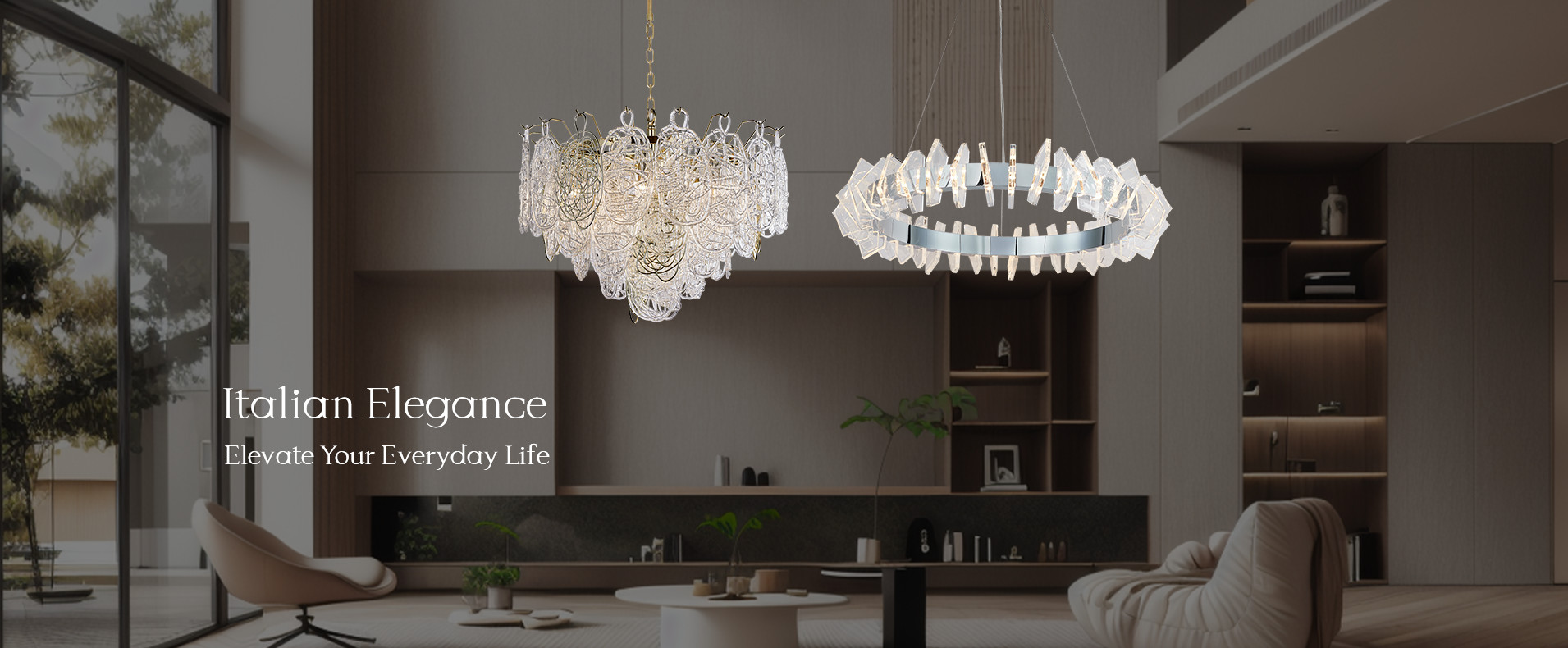
EVAN Lighting offers decorative pendant designs that combine Italian modern light-luxury styling with crystal and metal details. For example, its Vintage Italian Lamp features crystal details and a metal frame, with the product described as suitable for country kitchens and elegant dining spaces.
The appropriate model should be selected according to its actual dimensions, light output, suspension configuration, and installation requirements.
8. What Should Buyers Check Before Ordering Kitchen Island Pendant Lights?
For homeowners, interior designers, importers, and lighting project buyers, the hanging height should be confirmed before the pendant model and suspension components are finalized.
1. Overall Fixture Dimensions
Confirm the fixture diameter, total height, shade dimensions, canopy size, and minimum and maximum suspension length.
The lowest point of the installed fixture must provide the intended countertop clearance.
2. Suspension Adjustment
Check whether the pendant uses an adjustable cord, chain, or rod.
For projects with different ceiling heights, the available suspension range should be confirmed before ordering. Do not assume that every model can be shortened or extended without restrictions.
3. Electrical Specifications
Confirm the rated voltage, frequency, wattage, bulb base, integrated LED configuration, and dimming compatibility where applicable.
These details should be verified against the selected product's technical documentation and the destination market's requirements.
4. Materials and Finishes
The pendant should coordinate with the kitchen's cabinet handles, faucets, appliances, countertop materials, and other decorative elements.
Glass, crystal, and metal finishes can produce different visual effects. Sample approval is particularly useful for projects requiring consistent finishes across multiple fixtures.
5. Installation and Ceiling Support
Check the ceiling mounting structure, electrical outlet position, canopy dimensions, and total fixture weight.
For heavy decorative pendants, the ceiling support must be suitable for the fixture. Installation should follow the manufacturer's instructions and applicable local electrical requirements.
6. Manufacturing and Bulk Order Consistency
For residential developments, hospitality projects, and wholesale orders, buyers should confirm:
Approved product drawings and dimensions
Suspension length and adjustment range
Material and finish specifications
Light-source and electrical configuration
Sample approval and production consistency
Protective packaging for transportation
Production schedule and order quantities
EVAN Lighting is based in Guzhen, Zhongshan, China. Its approximately 12,000-square-meter production and showroom facility includes independent mold development, injection molding, die-casting, CNC processing, and finished-product production.
These manufacturing processes provide a foundation for decorative lighting development and production coordination. For project orders, product specifications and approved samples should be confirmed before bulk manufacturing.
9. Frequently Asked Questions
Can pendant lights hang lower than 30 inches above a kitchen island?
They may be positioned lower in certain designs, but the installation must maintain comfortable head clearance, clear sightlines, and suitable lighting performance. The manufacturer's instructions and the actual room layout should determine the final position.
Should kitchen island pendants hang at the same height?
Generally, yes. Matching heights create a consistent visual line and balanced lighting arrangement. Staggered heights may be used for intentionally layered designs, provided they do not obstruct movement or views.
Do higher ceilings require longer pendant cords?
Often, yes. Higher ceilings may require longer suspension components to achieve the desired relationship between the pendant and countertop. However, the fixture should not be raised automatically just because the ceiling is taller.
How high should pendant lights hang above a 36-inch kitchen island?
A common starting point is 30–36 inches above the countertop. This places the bottom of the pendant approximately 66–72 inches above the finished floor.
Should pendant lights be centered over a kitchen island?
Generally, yes. The fixture or group of fixtures should be centered over the usable island surface to create balanced illumination and visual alignment.
Are linear pendants better than individual pendants for long kitchen islands?
Linear pendants can provide a coordinated appearance and distribute multiple light points across a long surface. Individual pendants offer more flexibility in fixture selection and spacing. The best option depends on island dimensions, lighting requirements, and interior design.
Conclusion: How Can You Choose the Right Pendant Height?
For most standard kitchen islands, begin with the bottom of the pendant 30–36 inches above the countertop. Then adjust the installation according to ceiling height, fixture dimensions, light distribution, and standing sightlines.
The most reliable approach is to evaluate the fixture and countertop as one visual and functional arrangement. Correct height, balanced spacing, suitable light output, and coordinated decorative finishes all contribute to a successful kitchen lighting design.
With its Italian modern light-luxury styling, crystal lighting collections, and established manufacturing processes, EVAN Lighting provides decorative pendant options for residential and hospitality-inspired projects. Buyers should confirm dimensions, suspension specifications, and electrical details before finalizing an order.