


What Factors Affect the Brightness and Light Distribution of Ceiling Fixtures?
Ceiling fixture brightness and light distribution depend on lumen output, optical design, beam angle, diffuser materials, installation height, room dimensions, and surface reflectance. These factors determine how much light reaches a space and how evenly it is distributed.
What Determines the Brightness of a Ceiling Fixture?
The brightness of a ceiling fixture is influenced by several technical factors, not simply its wattage.
The most important factors include:
Lumen output: Lumens (lm) measure the total visible light emitted by a source. Higher lumen output generally means more available light.
Lighting efficacy: Measured in lumens per watt (lm/W), efficacy indicates how efficiently a light source converts electrical power into visible light.
Optical efficiency: Reflectors, lenses, diffusers, and fixture structures affect how much emitted light exits the fixture.
Light-source characteristics: LED modules and replaceable bulbs can differ in output, distribution, and operating performance.
Fixture construction: The shape and materials of the housing influence how light is transmitted, reflected, or blocked.
A key distinction is that wattage measures electrical power consumption, while lumens measure light output. A higher-wattage fixture is not necessarily brighter than a lower-wattage fixture.
For buyers comparing ceiling fixtures, lumen output and the fixture's actual light distribution are more useful starting points than wattage alone.
How Does Beam Angle Affect Ceiling Light Distribution?
Beam angle describes how widely light spreads from a fixture. It affects the illuminated area, the concentration of light, and the potential for uneven brightness.
| Beam Distribution | Typical Effect | Common Application |
|---|---|---|
| Narrow beam | Concentrated illumination | Accent lighting and selected architectural details |
| Medium beam | More controlled coverage | Focused general or supplementary lighting |
| Wide beam | Broader illumination | General room lighting |
| Diffuse distribution | Soft, broadly scattered light | Living rooms, bedrooms, and decorative interiors |
A narrow distribution can create bright spots with darker areas between fixtures if spacing is not planned correctly. A wider distribution can improve coverage, although the actual result depends on fixture output, mounting height, and optical design.
Beam angle should not be evaluated in isolation. Two ceiling fixtures with similar beam angles may produce different lighting patterns because their reflectors, lenses, and internal structures differ.
For more accurate comparisons, buyers and lighting professionals can review photometric data, including luminous-intensity distribution curves and IES files where available.
How Do Diffusers, Reflectors, and Lenses Influence Light Output?
The optical components inside a ceiling fixture play a major role in determining how light leaves the housing.
Diffusers
Diffusers scatter light to create a more uniform luminous appearance and reduce direct visibility of the light source. However, some diffusers absorb or redirect part of the light, which can reduce the fixture's delivered output.
Reflectors
Reflectors redirect light toward selected areas. Their shape, surface finish, and reflectivity influence whether the fixture produces concentrated or broader illumination.
Lenses
Lenses control how light is transmitted and distributed. Depending on their optical design, they can spread, focus, or redirect light.
Decorative crystal elements
Crystal components create reflective highlights and visual sparkle by interacting with light. Their arrangement and geometry influence the decorative effect, but visual sparkle should not be confused with overall room brightness.
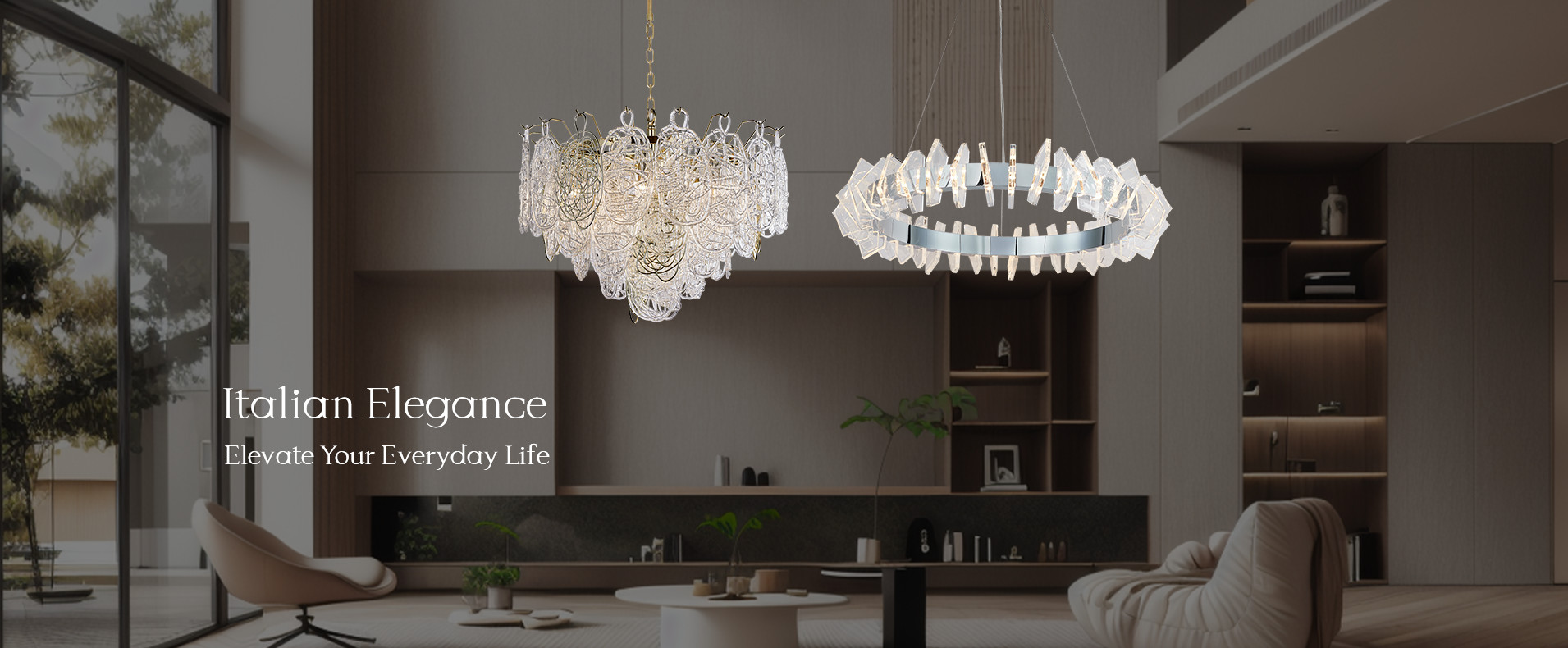
For example, EVAN Lighting's Crystal Circle Mount Ceiling Light uses an arrangement of crystal elements to create decorative visual effects. When selecting this type of fixture, buyers should consider both its decorative appearance and its suitability for the room's general illumination requirements.
Does Ceiling Height Affect Brightness and Light Distribution?
Yes. Installation height changes how light spreads and how much illumination reaches a particular surface.
As the distance between a fixture and the illuminated surface increases, light generally covers a larger area but becomes less concentrated. The actual illuminance also depends on the fixture's intensity distribution and aiming direction.
| Ceiling Condition | Potential Lighting Effect | Selection Consideration |
|---|---|---|
| Low ceiling | Limited distance for light to spread | Consider broad, comfortable distribution and fixture clearance |
| Standard ceiling | More flexible fixture placement | Balance output, coverage, and decorative proportions |
| High ceiling | Greater distance to the illuminated area | Check delivered illuminance and whether supplementary lighting is needed |
| Sloped ceiling | Light may distribute unevenly | Confirm mounting compatibility and light direction |
A common selection mistake is choosing a fixture based only on its appearance without considering the mounting height.
A decorative ceiling light that looks substantial in a showroom may not deliver sufficient illumination when installed in a large room with a high ceiling.
How Do Room Size and Surface Colors Affect Perceived Brightness?
Room dimensions and interior finishes influence how bright a space appears, even when the same ceiling fixture is used.
Room size: Larger spaces generally require more total light or a coordinated arrangement of multiple fixtures.
Ceiling color: Light-colored ceilings reflect more light, while dark finishes absorb more of the incident light.
Wall color: Light walls can help distribute illumination throughout the room. Dark walls may make the same lighting arrangement appear less bright.
Floor and furniture finishes: Reflective, matte, light, and dark surfaces affect how light is redistributed within the space.
Room layout: Partitions, furniture, decorative structures, and ceiling features can create shadows or obstruct light.
This explains why two rooms with identical ceiling fixtures may have noticeably different lighting results.
For practical planning, fixture selection should consider the room's dimensions, ceiling height, surface reflectance, furniture layout, and intended activities together.
What Is the Difference Between Lumens, Lux, and Color Temperature?
These lighting measurements describe different properties and should not be treated as interchangeable.
| Measurement | What It Describes | Why It Matters |
|---|---|---|
| Lumens (lm) | Total visible light output | Indicates the light produced by a source or fixture |
| Lux (lx) | Illuminance on a surface; one lumen per square meter | Indicates how much light reaches a particular area |
| Watts (W) | Electrical power consumption | Helps assess energy use |
| Lumens per watt (lm/W) | Lighting efficacy | Indicates light output relative to power consumption |
| Kelvin (K) | Correlated color temperature (CCT) | Describes whether light appears warmer or cooler |
| CRI | Color Rendering Index | Indicates how accurately colors appear under the light |
Color temperature does not directly measure brightness. However, warm and cool light can create different visual impressions in the same interior.
Similarly, a fixture with a high lumen rating does not guarantee sufficient illumination at a desk, countertop, or floor. The distance, distribution, and illuminated area also matter.
How Does Fixture Design Affect Light Uniformity and Glare?
A ceiling fixture's shape and optical structure influence whether illumination is evenly distributed or concentrated in particular directions.
Several design characteristics are especially important:
Light-emitting surface: A larger luminous surface can create a different visual brightness pattern from a small, concentrated source.
Shade geometry: Openings and shade contours determine where light can escape.
Reflective surfaces: Internal reflective finishes redirect light and influence distribution.
Diffuser construction: Material transparency and surface treatment affect light transmission and uniformity.
Shielding: Appropriate shielding can reduce direct visibility of bright light sources.
Glare occurs when excessive brightness or contrast causes visual discomfort. A fixture can produce high light output while still being uncomfortable if the light source is directly visible or poorly controlled.
The goal is not simply to maximize brightness. It is to provide suitable illumination while maintaining visual comfort.
How Many Ceiling Fixtures Are Needed for Even Lighting?
The number of fixtures depends on room dimensions, required illuminance, fixture output, distribution pattern, and installation conditions.
A practical planning process includes:
Measure the room: Record its length, width, and ceiling height.
Identify the lighting purpose: Determine whether the room needs general illumination, task lighting, accent lighting, or a combination.
Estimate the required light level: Select an appropriate illuminance target for the room's activities.
Review fixture output: Compare delivered lumens rather than relying only on electrical wattage.
Check distribution patterns: Consider beam angle, optical design, and fixture spacing.
Evaluate the layout: Avoid excessive overlap in some areas and insufficient illumination in others.
Review the final arrangement: Where available, use photometric calculations or lighting simulation to assess uniformity.
A simple lumen-method estimate can provide an initial planning reference:
Estimated fixture lumens = Target illuminance (lux) × Room area (m²) ÷ (Utilization factor × Maintenance factor)
This is a preliminary calculation, not a final lighting design. The utilization and maintenance factors depend on the room, fixture, surface reflectance, and operating conditions.
For projects with complex layouts, high ceilings, or demanding visual tasks, photometric calculations are more reliable than estimating fixture quantities from room area alone.
What Should Buyers Check When Sourcing Ceiling Fixtures for Residential and Commercial Projects?
For importers, distributors, designers, and hospitality procurement teams, brightness and light distribution should be included in the technical review before confirming an order.
| Purchasing Factor | What to Verify | Why It Matters |
|---|---|---|
| Lumen output | Rated light output and whether it refers to the source or complete fixture | Establishes the available illumination |
| Beam distribution | Beam angle and photometric data where available | Helps predict coverage and uniformity |
| Optical components | Diffuser, reflector, lens, and decorative elements | Influences delivered light and visual effects |
| Color temperature | Specified Kelvin value | Supports consistent interior atmosphere |
| Color rendering | CRI information | Important where accurate color appearance matters |
| Fixture dimensions | Diameter, height, and projection | Helps confirm room and ceiling compatibility |
| Light-source design | Replaceable bulb or integrated LED | Affects maintenance and replacement planning |
| Driver compatibility | Electrical specifications and dimming requirements | Helps ensure system compatibility |
| Installation details | Mounting method, wiring, and ceiling conditions | Reduces installation uncertainty |
| Finish consistency | Material, color, and surface treatment | Supports coordinated project delivery |
A useful procurement principle is to evaluate the complete fixture rather than judging the light source separately. The optical structure, decorative materials, and installation environment all contribute to the final result.
EVAN Lighting is a decorative lighting manufacturer based in Guzhen, Zhongshan, China. Its product range includes Italian modern light luxury lighting fixtures and high-end crystal lighting.
The company operates an approximately 12,000-square-meter production and exhibition facility, with manufacturing processes including independent mold development, injection molding, die-casting, CNC processing, and finished-product production.
These manufacturing capabilities support decorative fixture development and coordination across product categories. For buyers evaluating ceiling lighting for residential and hospitality projects, the EVAN Lighting Ceiling Lamp Collection provides a starting point for reviewing available designs.
Frequently Asked Questions
Does higher wattage mean a brighter ceiling fixture?
No. Wattage measures electrical power consumption, while lumens measure visible light output. A more efficient fixture can produce more lumens while consuming less power.
What makes a ceiling light distribute illumination unevenly?
Common causes include unsuitable beam angles, incorrect fixture spacing, excessive mounting height, obstructions, poor optical design, and differences in surface reflectance.
Do Crystal Ceiling Lights provide enough general illumination?
They may contribute to general illumination, but suitability depends on the complete fixture's light output and distribution. Decorative sparkle alone does not establish whether a fixture can adequately illuminate a room.
Does a diffuser reduce ceiling fixture brightness?
A diffuser can reduce delivered light because some light may be absorbed or redirected. Its effect depends on material transparency, thickness, surface treatment, and construction.
Is a wide beam angle always better for ceiling lighting?
No. Wide distributions can provide broader coverage, but some applications require more concentrated illumination. The appropriate distribution depends on room dimensions, mounting height, and lighting purpose.
How can buyers compare the actual lighting performance of two ceiling fixtures?
Compare fixture-level lumen output, beam distribution, optical design, color temperature, CRI, and available photometric data. Product dimensions and installation conditions should also be considered.
Conclusion: How Can the Best Ceiling Fixture Lighting Performance Be Achieved?
Good ceiling lighting depends on balancing light output, optical distribution, installation height, room conditions, and visual comfort.
For general illumination, the fixture should distribute light across the required area without creating excessive dark spots or glare. For decorative applications, optical components and materials should also support the intended visual effect.
The most reliable selection process evaluates the complete fixture in its actual installation environment rather than relying on wattage, appearance, or lumen output alone.