

How Do Crystal Pendant Lights Create Different Lighting Effects in Interior Spaces?
Crystal pendant lights create different effects by reflecting, refracting, and redirecting light through their crystal elements. Their appearance depends on crystal cut, light-source position, fixture structure, and surrounding surfaces.
1. How Do Crystal Pendant Lights Create Sparkling Effects?
The sparkling effect comes from light interacting with multiple crystal facets. Each cut surface can redirect light in a different direction, producing small highlights that change as people move through the room or view the fixture from different angles.
The result depends on more than the number of crystals. Crystal clarity, facet geometry, spacing, and the intensity and position of the light source all influence the visible sparkle.
For interior projects, the most effective design is not necessarily the one with the most reflective elements. A balanced arrangement creates visual interest without overwhelming nearby furniture, finishes, or other decorative features.
2. How Does Crystal Refraction Change the Appearance of Light?
Refraction occurs when light changes direction as it passes between materials with different optical properties. Faceted crystal elements can bend and redirect light, creating highlights and, under suitable conditions, subtle spectral color effects.
Different crystal shapes produce different visual results:
Flat-cut elements: Create defined highlights and a more structured appearance.
Multi-faceted crystals: Produce multiple reflections and more noticeable sparkle.
Long crystal drops: Create layered highlights and a sense of vertical movement.
Geometric crystal arrangements: Form a more controlled, contemporary decorative pattern.
The final effect also depends on the light source and viewing angle. Crystal should therefore be evaluated as part of the complete fixture rather than as an isolated material.
3. Can Crystal Pendant Lights Create Different Shadow and Reflection Patterns?
Yes. Crystal elements, metal frames, and the shape of a pendant can influence how light and shadow appear on nearby surfaces.
A fixture with separated crystal drops may create a different pattern from one with closely arranged geometric elements. Polished metal can add reflected highlights, while surrounding walls, ceilings, mirrors, and stone surfaces influence how those highlights are perceived.
For designers, this creates an opportunity to coordinate the fixture with the interior:
Use more structured crystal arrangements in rooms with clean architectural lines.
Use layered or cascading details where a stronger decorative focal point is desired.
Consider wall and ceiling finishes before selecting highly reflective designs.
Review the fixture from normal viewing positions to understand where reflections will appear.
A useful design principle is to treat the crystal pendant as both a light fixture and a reflective interior element.
4. How Do Crystal Pendant Lights Create Ambient and Accent Lighting?
Crystal pendants can contribute to ambient illumination and decorative accent lighting, but the balance depends on their construction and light-source arrangement.
| Lighting effect | How the fixture contributes | Suitable design application |
|---|---|---|
| Ambient effect | Light is distributed through or around the fixture | General decorative illumination in living and dining spaces |
| Accent effect | Bright highlights draw attention to the pendant and nearby details | Feature areas, reception spaces, and selected interior focal points |
| Reflective effect | Crystal and polished surfaces redirect visible light | Interiors with glass, stone, or metallic finishes |
| Decorative sparkle | Facets create multiple points of brightness | Luxury residential and hospitality interiors |
| Layered effect | The pendant works with other independent light sources | Rooms requiring different lighting moods and functions |
A crystal pendant should not automatically be treated as the only source of room illumination. A well-planned interior usually combines decorative pendants with suitable general, task, or wall lighting.
5. How Do Crystal Shape and Fixture Structure Affect Lighting Performance?
The arrangement of crystal elements determines how the fixture looks from different directions and how light interacts with its structure.
Linear arrangements can create a more directional visual rhythm and work well above elongated tables or counters.
Tiered arrangements add depth and layered reflections, making the fixture more visually prominent.
Circular arrangements create a balanced appearance around a central structure and can complement round or symmetrical interiors.
Cascading arrangements emphasize vertical movement and can be used where ceiling height and installation clearance allow.
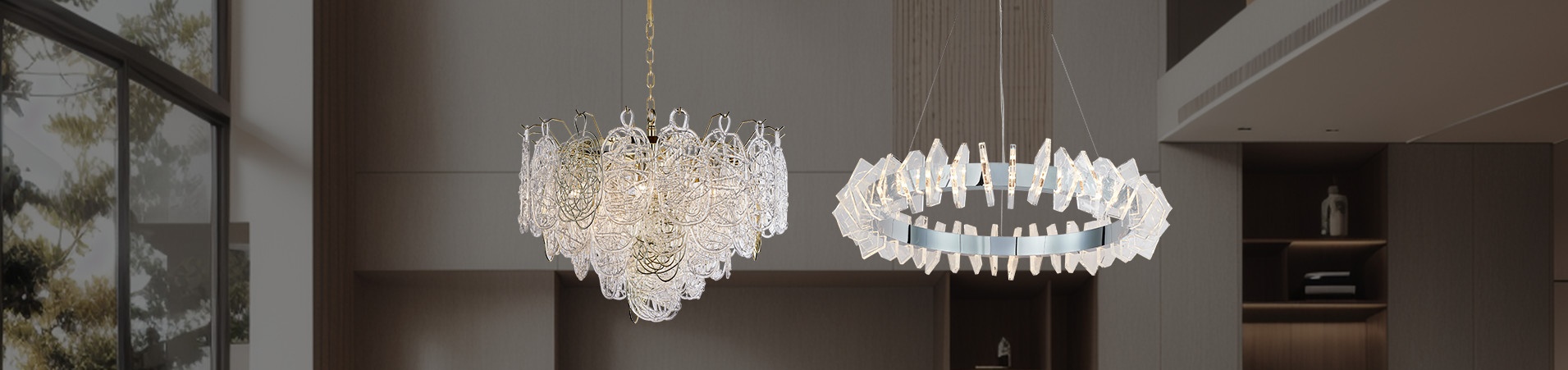
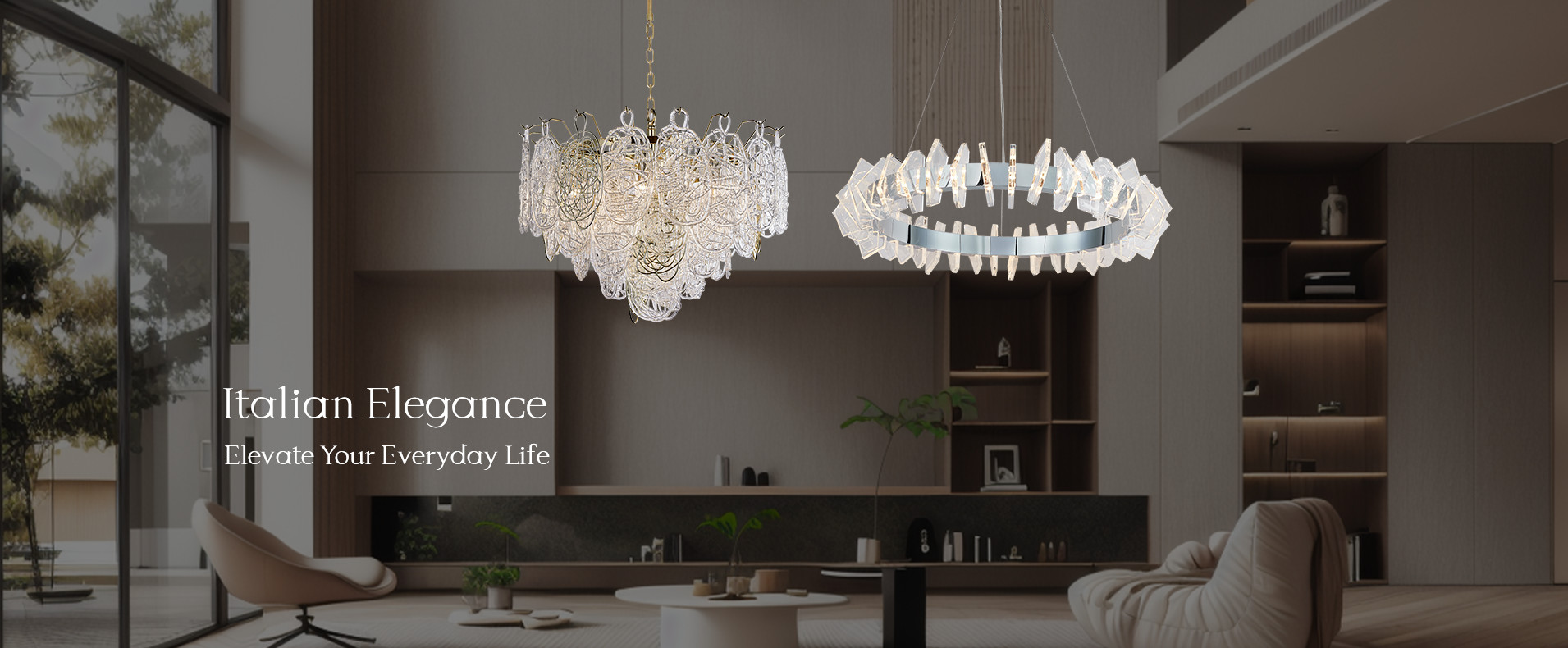
EVAN Lighting's Vintage Italian Crystal Pendant Lamp uses descending crystal elements to scatter light from different angles. The design illustrates how crystal placement can contribute to both visual movement and decorative illumination.
For a more contemporary approach, the Tiered Ring LED Crystal Chandelier combines polished chrome rings with embedded crystal details. Its tiered structure creates a distinct geometric visual effect.
6. How Do Light Color and Brightness Influence Crystal Effects?
The light source changes how crystal details are perceived.
Warm white light generally creates a softer, more intimate atmosphere and can complement warm metallic finishes.
Neutral white light offers a more balanced appearance for contemporary interiors and mixed material palettes.
Cool white light can create a sharper visual impression, although it may feel less inviting in some residential and hospitality settings.
Brightness also matters. A compact, intense light source may create strong points of sparkle, while a more diffuse source can produce a softer overall appearance.
However, stronger sparkle does not necessarily mean better room lighting. Designers should evaluate visual comfort, glare, color appearance, and the actual illumination required for the space. Where dimming is supported, adjustable output can help the pendant serve different activities and times of day.
7. Where Do Different Crystal Pendant Lighting Effects Work Best?
The appropriate effect depends on the room's function, ceiling conditions, furniture layout, and interior style.
| Interior space | Recommended visual effect | Selection consideration |
|---|---|---|
| Dining room | Focused sparkle and a clear decorative focal point | Coordinate the fixture with the table shape and viewing angles |
| Living room | Balanced reflections and ambient contribution | Avoid excessive visual competition with other reflective finishes |
| Hotel reception | More prominent layered or cascading effects | Check ceiling height, installation access, and overall scale |
| Bedroom | Softer decorative highlights | Prioritize comfortable brightness and control of direct glare |
| Kitchen island | Structured or linear crystal arrangements | Consider task lighting, cleaning access, and clearance |
| Staircase or high-ceiling space | Vertical movement and layered reflections | Confirm suspension, structural support, and maintenance access |
The key is to match the optical character of the pendant with the role of the space. A highly decorative fixture may be appropriate as a focal point, while a simpler crystal design can complement an interior without dominating it.
8. What Should Buyers Consider When Selecting Crystal Pendant Lights?
For designers, developers, and importers, product selection should include both visual evaluation and technical review.
Before confirming an order, check:
Crystal consistency: Review clarity, cutting, visible defects, and arrangement uniformity.
Frame construction: Confirm the frame material, finish, connection points, and overall stability.
Light-source compatibility: Check lamp type, wattage limits, voltage, and any integrated LED or driver specifications.
Fixture dimensions: Confirm overall diameter, height, suspension length, and ceiling clearance.
Lighting effect: Review the sample under realistic lighting conditions and from different viewing angles.
Installation requirements: Confirm mounting details and suitable structural support.
Maintenance access: Evaluate how crystal elements and serviceable components can be cleaned or replaced.
Packaging and inspection: Agree on protective packaging and inspection criteria for fragile decorative components.
A practical manufacturer-side recommendation is to assess a physical sample against the project's actual finishes and lighting conditions. Product photographs alone may not reveal how crystal reflections interact with polished stone, mirrors, metal, or textured walls.
9. How Does EVAN Lighting Support Decorative Crystal Pendant Projects?
EVAN Lighting focuses on high-end decorative lighting, including Italian modern light luxury fixtures and crystal lighting designs. The company is based in Guzhen, Zhongshan, and describes a production operation covering approximately 12,000 square meters.
Its manufacturing processes include independent mold development, injection molding, die-casting, CNC processing, and finished-product production. These processes provide a foundation for coordinating decorative structures, metal components, and crystal details.
Buyers can explore the EVAN Pendent Lamp collection to review different decorative directions, including vintage, geometric, tiered, and contemporary crystal designs.
For project sourcing, the final specification should be confirmed with the manufacturer, including dimensions, materials, finish, electrical requirements, installation details, sample approval, and production consistency.
10. What Is the Main Difference Between Crystal Pendant Lighting Effects?
Crystal pendant lights can create sparkle, refraction, reflected highlights, decorative shadows, and ambient visual depth. These effects are shaped by crystal geometry, fixture structure, light-source characteristics, and the surrounding interior.
The most suitable design is not simply the brightest or most elaborate fixture. It is the one that produces the intended visual effect while maintaining comfortable illumination, appropriate proportions, and practical installation and maintenance requirements.